Day 2Thursday 2 July
Your ETH trade was oversized and front-ran the trigger, revealing old habits of impatience. BTC and HYPE shorts were against the higher-timeframe trend, leading to preventable losses. This session underscores the importance of adhering strictly to your rules, especially trading with the trend and waiting for proper confirmation. Stick to the plan: wait for confirmation and size properly to avoid unnecessary heat.
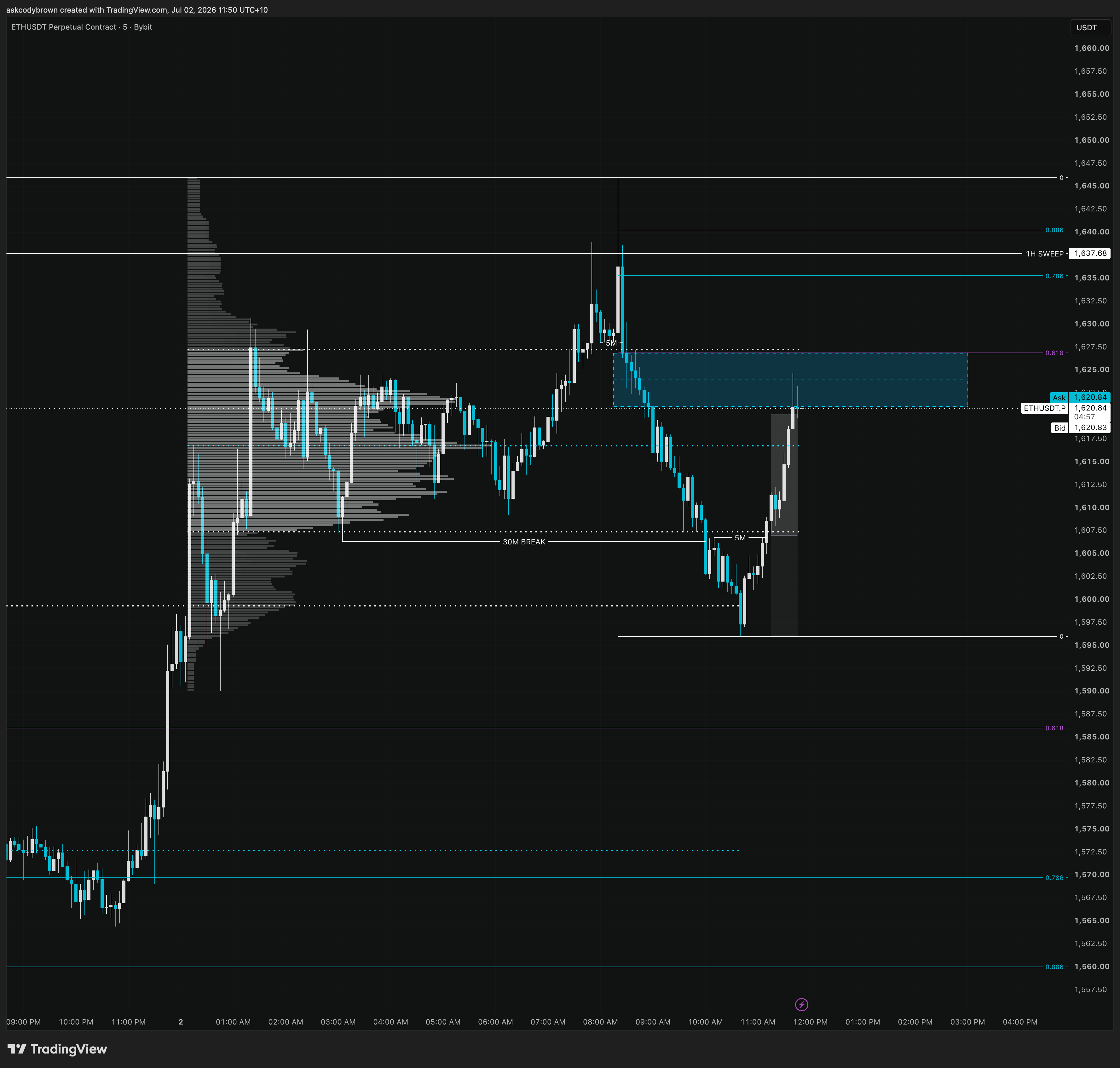
Why I took it. The 1-hour had swept its range highs and I was still reading it bullish, looking for the move back up into the value area high of the 30-minute bearish leg, with the golden pocket sitting just above it. Honestly, this one is a counter trade: the 30-minute had broken down, and that should have been my higher timeframe. The plan was to anticipate the turn and scale in off a lower-timeframe break of structure, stop at 1,596 under the low, target 1,620 just past the 15-minute point of control for a 1.2R base hit.
How it played out. The first tranches went on early, at 1,611.77 and 1,610.24, before any structure had broken. That is the front-run: the 5-minute break is my trigger and I did not wait for it. Price sank to 1,596.75, within about a dollar of my stop, and the scale-ins fired off a 1-minute break of structure down there. I also ended up oversized, roughly double what I wanted on, so I cut half back at break-even as soon as it recovered and let the rest hit the 1,620 target. It kept running to about 1,625 after I was out, a 1.6R I watched from the sidelines. The day banked +$76 and the target got hit, but the R on the risk I actually carried was +0.51, the heat peaked at 27% of the account, and Temper was offline the whole session while I was mid-build on the app. The trade worked. The process was the old me.
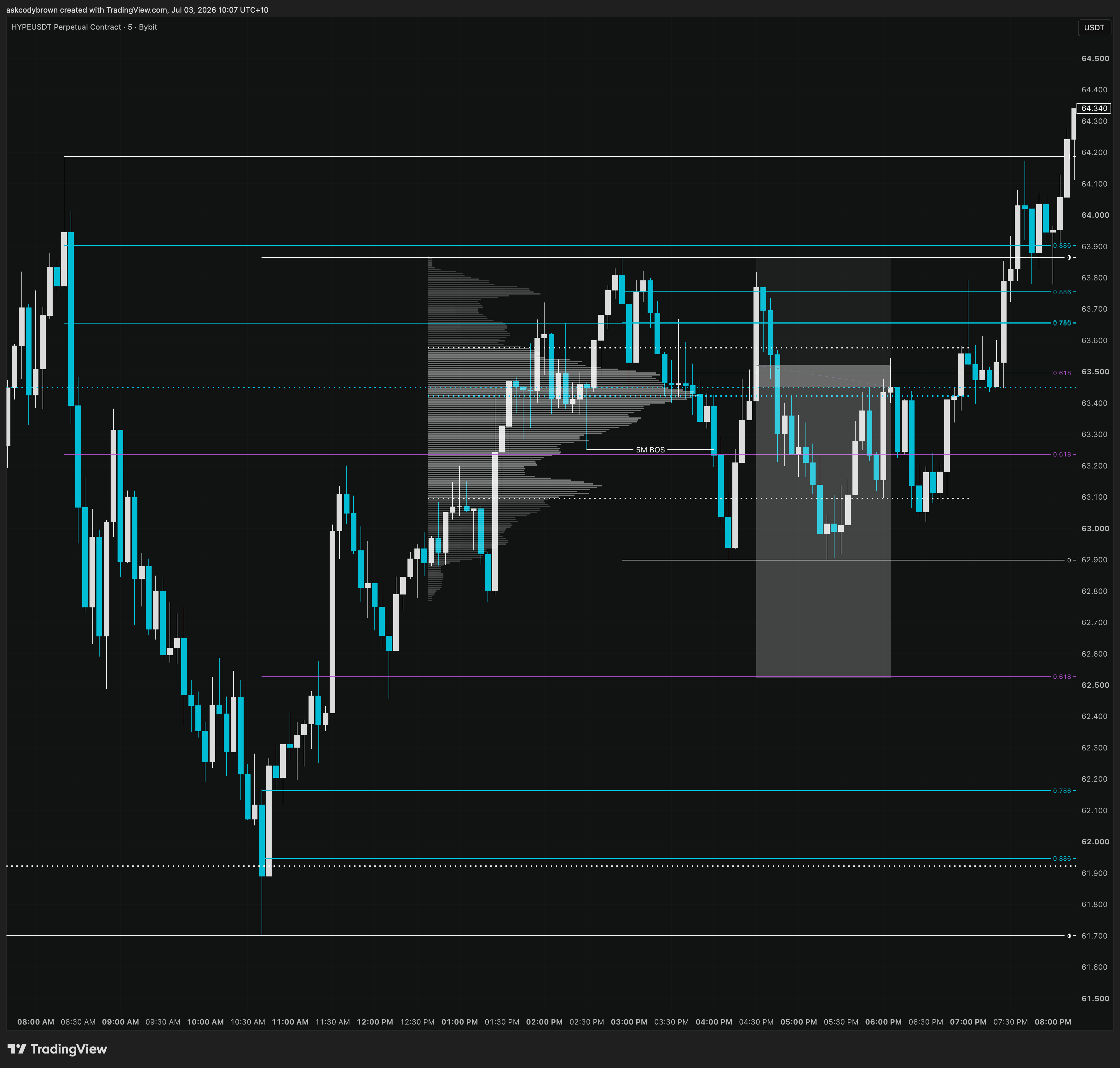
Why I took it. The 1-hour on HYPE had bearish market structure and I was looking for the pullback into the premium of that 1-hour leg. We pulled all the way into the 0.886, filled the final fair value gap of the leg (a 5-minute gap), and pushed through the 1-hour range point of control rather than rejecting off it, so the real rejection was the gap fill plus the 0.886. The 5-minute then broke structure to the downside, so the low timeframe turned bearish in line with the high timeframe I was playing. On the push down we got a low-timeframe retrace back beyond the 0.886, straight through the value area high of the local range, and I shorted it. Stop 63.866 above the swing, target 62.52 at the 0.618 of the 5-minute leg. That target was nearly 1:3, and that was mistake number one: reaching for the home run instead of the base hit.
How it played out. It dug about 0.9R against me before it went, then pushed down hard. At the extreme the move was worth 1.8R, but my take-profit was set deeper at 62.52 and the move stopped short of it. I was at work and couldn't manage it live, so the low-hanging 1.8R went untaken. Once I saw it at +1.2R I moved my stop to break-even, and the bounce took me out flat, minus six dollars in fees. The part I'm actually proud of: I didn't re-enter after the stop-out, which is exactly what the old me does. Stayed composed, logged the mistakes, and waited for the next setup instead. Temper was offline again while I'm mid-build on the app.
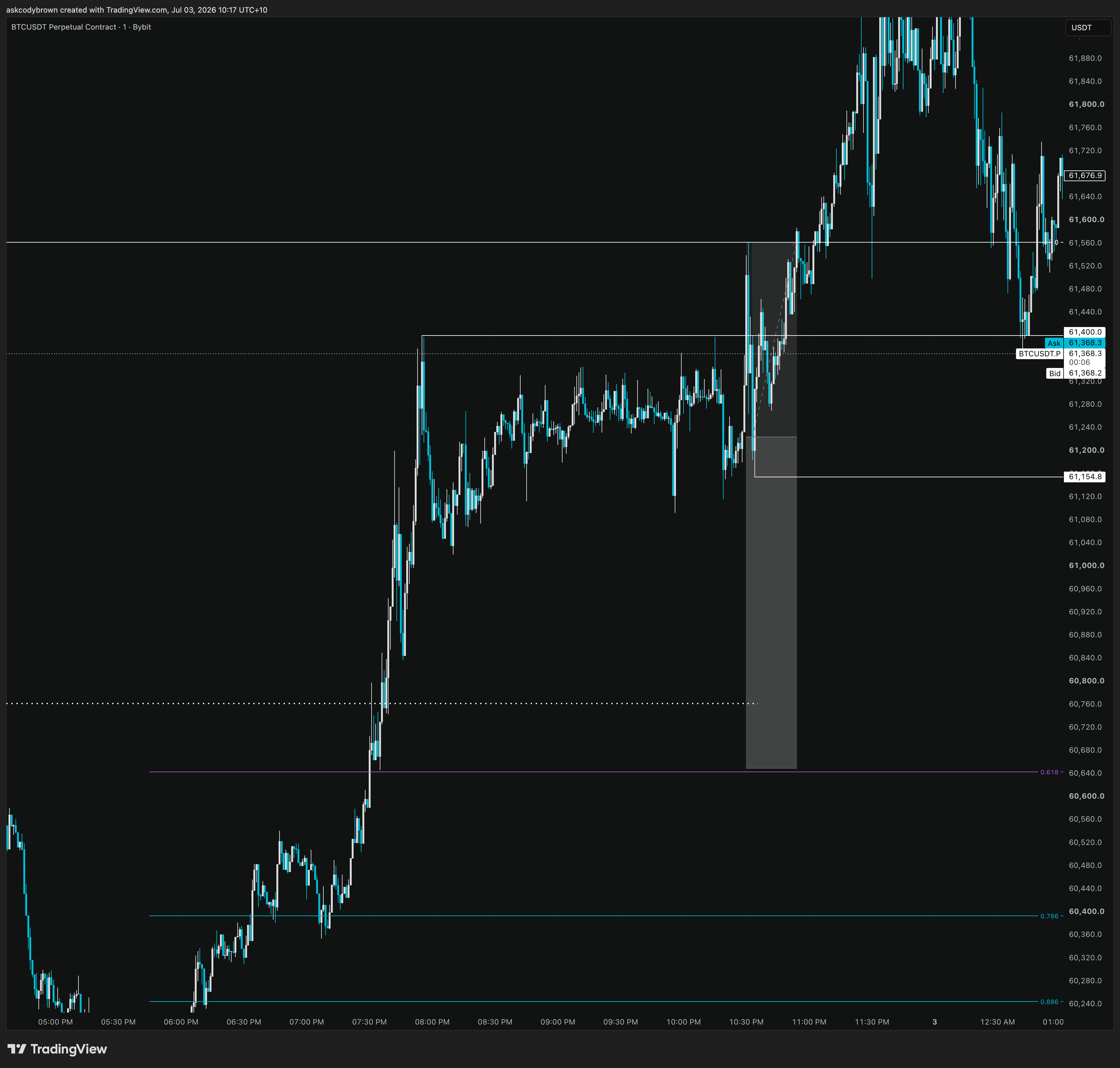
Why I took it. The 1-hour had wicked through its range highs and closed back below, and to me a wick is not a break: until we close above those highs, high-timeframe structure is still bearish. So I was hunting a short off that liquidity grab, looking for a lower-timeframe break of structure to confirm. I never got one, not even on the 1-minute. I took it anyway. I was too eager, I front-ran a break that never came, and I was way too zoomed in: playing a 1-minute trigger on a 1-hour idea when it should have been a 5-minute at least. Target was the 0.618 of the 15-minute bullish leg at 60,640, which also lined up with the previous value area high of the 1-hour range, about a 1:1.7.
How it played out. There was nothing actually pushing us down. The whole market was bullish and it just kept going: price ripped straight through my stop at 61,560 and filled me at 61,576, a full 1R stop-out with a bit of slippage and the fees on top. Bad trade for three reasons: I got stopped out, the read on the market was bad, and I broke my rules to be in it at all. What I did do right: risk was $27, inside the 5% rule, so the damage was one unit, not a hole. Temper was offline again, and honestly that was the biggest mistake of the lot: this is exactly the trade it exists to talk me out of.
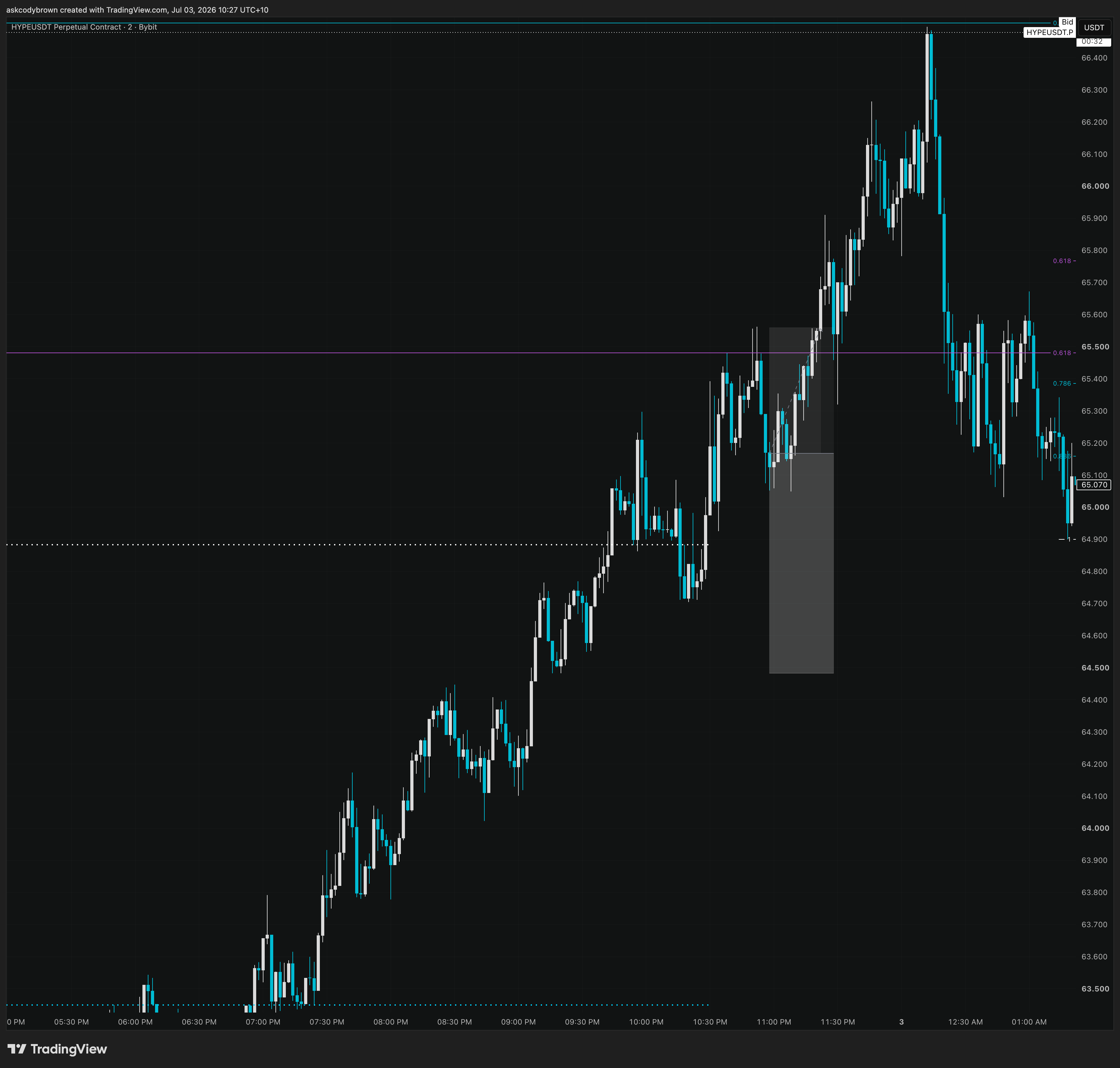
Why I took it. We had just tapped the 0.618 of the 4-hour leg, and the 4-hour was still in a downtrend, so I was hunting the short off that level. A 2-minute break of structure to the downside came in and matched the 4-hour read, so I took it: stop 65.563, target 64.484, about 1.5R. The mistake is in the middle of that sentence: the 1-hour and 15-minute were both clearly bullish and had just broken structure to the upside, and a 2-minute trigger has no business confirming a 4-hour idea. If I'm playing a 1-or-2-minute break, it should be against a 15-minute leg, not a 4-hour one. On top of that, price had just reclaimed the higher-timeframe value area high, and my target needed us back below it. The smarter read was that the VAH would hold as support after being reclaimed.
How it played out. It went about 0.2R in my favour and then straight back against me. Stopped out at 65.568, a full 1R unit gone, plus the fees. Four minutes after the BTC stop-out, which is the part the numbers won't let me hide. What I did right, again: risk was $33, right around the 5% rule instead of the 7-8% I used to swing, so two losses back to back still only cost two units. Temper stayed offline the whole session. Lesson logged: match the trigger timeframe to the leg you are actually trading, and respect a reclaimed level instead of fading it.
The tool that calls me out.
The strategy was never the hard part. Following it was. Temper is the app I'm building to call out the rule-break in the moment, before it costs me.
See Temper ↗